
Thickness Choices in Birch: 12 mm, 18 mm and 24 mm
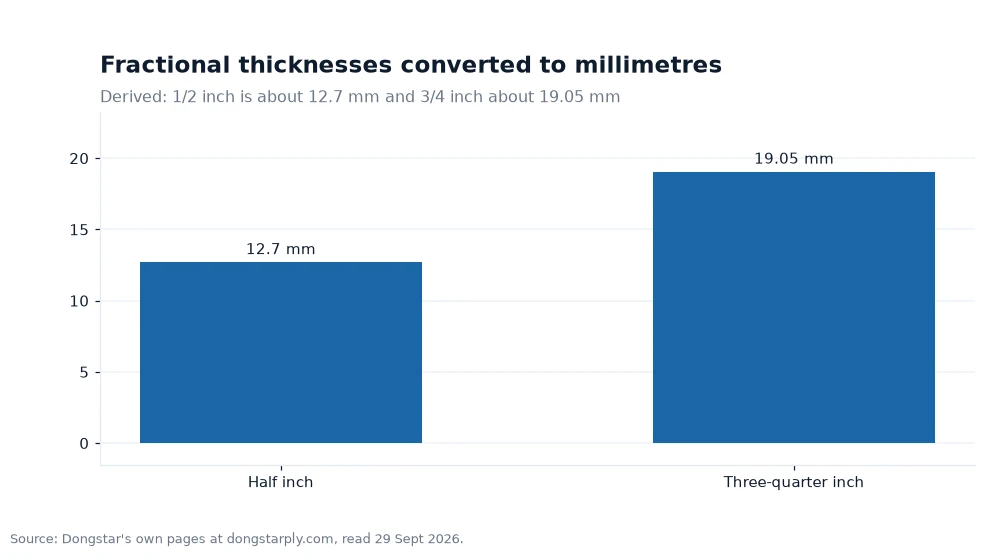
Three thicknesses anchor the birch range: 12 mm for fine joinery, 18 mm for floors and cabinets, and 24 mm for heavy, marine and industrial work. Sheets come in the 4 × 8 format, and the imperial equivalents are published alongside the metric figures, with half an inch at about 12.7 mm and three-quarters at about 19.05 mm. Because the species is heavy and stiff, the thickness decision changes freight, handling and fixing as much as it changes strength.

Key takeaways
- The range is built on three steps: 12 mm for fine joinery, 18 mm for floors and cabinets, 24 mm for heavy, marine and industrial duty.
- Half an inch converts to about 12.7 mm and three-quarters to about 19.05 mm, so a metric sheet and an imperial drawing never match exactly.
- Betula Alleghaniensis is dense, hard and stiff, which is why pre-drilling is recommended for fixings near edges and corners.
- Thickness multiplies freight volume: a 24 mm sheet occupies twice the cubic space of a 12 mm sheet of the same area.
Three thicknesses, three different jobs
The three thicknesses published for Birch Plywood are not a ladder from good to better; they are three answers to three questions. Thin panels suit work where a component is detailed and lightly loaded. Mid-thickness panels carry everyday structural duty in furniture and floors. Thick panels take abuse, moisture and heavy cyclic loading in industrial and marine settings.
That framing matters when a project mixes all three, which is common in shop fitting and boat interiors. A single order can hold 12 mm door skins, 18 mm carcass sides and 24 mm structural members, and each line should be justified by the duty it performs rather than by a general preference for thicker material.
The 24 mm step and heavy service
The thickest sheet in the range is published for heavy-duty, marine and outdoor furniture as well as industrial applications. The reason is straightforward: load capacity and stiffness scale with thickness, and so does the stock of material available for fixings, rebates and repeated assembly. A component that is bolted, unbolted and adjusted again needs enough material around the fastener to survive that cycle.
The same thickness carries a penalty. At 24 mm, a 4 × 8 sheet measures 1.22 × 2.44 = 2.9768 m² and occupies 2.9768 × 0.024 = 0.0714 m³, so a modest order in this step fills a container quickly and needs two people to move by hand. Specifying it where 18 mm would do is an expensive habit, and one that is easy to spot once the cubic numbers are written down.
The 18 mm step for floors, cabinets and structure
Eighteen millimetres is the middle of the range and the busiest step in most joinery shops. The published applications are flooring, cabinets and structural components, and the thickness suits each of them for a slightly different reason. Floors need stiffness across a span, cabinet carcasses need sufficient edge material for dowels, screws and hinges, and structural components need a predictable section.
For anyone working from imperial drawings, this is also the step with the widest expectation gap. Three-quarters of an inch is about 19.05 mm, so a drawing that calls for 3/4 inch stock is asking for roughly a millimetre more than an 18 mm sheet supplies. On a single shelf the difference is invisible; across a stack of 40 panels it changes the overall height of a cabinet run.
The 12 mm step and fine joinery
Twelve millimetres is published for fine joinery, where components are smaller, details are tighter and the panel is usually supported by a frame or a substrate. Drawer bases, cabinet backs, light partitions, jigs and turned or shaped components all sit comfortably in this step, and the lower weight makes a difference on doors and moving parts.
Two practical points apply at this thickness. Cutting a 12 mm sheet produces less edge to glue and screw, so joinery details need designing for the material rather than borrowed from a thicker assembly. And because the wood is dense and hard, pre-drilling matters as much here as on the heavier sheets — a thin, stiff panel splits just as readily as a thick one when a screw is driven straight in near an edge.
Working between metric sheets and imperial drawings
The published equivalents exist for exactly this reason: 1/2 inch ≈ 12.7 mm, 3/4 inch ≈ 19.05 mm. Neither figure lands on a metric step, so a specification drawn in inches will always be approximated by the closest sheet in the range. The question is which direction to round and what the rounding does to the assembly.
Rounding down saves volume and cost and slightly reduces stiffness. Rounding up does the opposite. For most furniture work the difference is absorbed by fixings and allowances, but for stacked components, door gaps or load-bearing sections it should be checked deliberately — ideally before the cutting list is issued rather than after the first cabinet is assembled.
| Thickness | Published application | What it changes on the job |
|---|---|---|
| 12 mm | Fine joinery | Light components that a frame or substrate supports |
| 18 mm | Floors, cabinets, structural components | Edge material for hinges, dowels and fixings |
| 24 mm | Heavy-duty, marine and industrial work | Load capacity and material for repeated assembly |
| 1/2 inch | About 12.7 mm | Imperial drawings met by the closest metric sheet |
| 3/4 inch | About 19.05 mm | Roughly a millimetre above the 18 mm step |
Worked example: a floor job priced in inches and cut in millimetres
A fitter has 90 m² of flooring substrate to lay, and the drawing calls for 3/4 inch stock. One sheet covers 1.22 × 2.44 = 2.9768 m², so 90 ÷ 2.9768 = 30.2 sheets — 31 sheets with an allowance for trimming (example arithmetic). If the number of sheets is fixed at 31, the difference between the drawing and the delivered panel is easy to state: 3/4 inch is about 19.05 mm against an 18 mm sheet, a shortfall of about 1.05 mm per sheet (example).
Over the whole job that shortfall adds up to 31 × 2.9768 × 0.00105 = 0.0969 m³ of material the drawing expected and the delivery does not contain (example). Nobody notices 0.0969 m³ on a building site, but the same arithmetic applied to a 600-sheet container changes the freight bill and the section properties in ways a buyer would rather know about in advance.
Frequently asked questions
Which thickness should be ordered for a floor?
Eighteen millimetres is the published step for flooring, cabinets and structural components. Twelve millimetres is intended for fine joinery, and the 24 mm sheet is listed for heavy-duty, marine and industrial applications.
Does an 18 mm panel match a 3/4 inch drawing?
Not exactly. Three-quarters of an inch is about 19.05 mm, so an 18 mm sheet is roughly a millimetre thinner than the drawing expects. Half an inch, at about 12.7 mm, sits slightly above the 12 mm step in the same way.
Is thicker always the safer specification?
No. Extra thickness adds load capacity but also weight, freight volume and cost, and a 24 mm sheet takes twice the cubic space of a 12 mm sheet of the same area. The published application list is the better guide to what each step is for.
Where to check the specification next
Thickness is one line of a timber specification that also covers species, origin and machining behaviour. Buyers who want the surrounding detail can read the wider panel range and the background on the group that makes it before a cutting list is issued.
Thicknesses, imperial equivalents and application notes are based on the maker's site, read on 29 September 2026, as applied to the chart above, and taken for this write-up[1].