
Quality Control Checkpoints for Private Label Fragrance Orders
Quality control in a private-label fragrance order is a chain of checkpoints from raw material to pallet, and the two checkpoints that predict everything else are the batch record and the retained sample. Retailers who treat QC as an inspection at the end get products that pass the inspection and fail the customer; retailers who trace QC back to the approved reference get repeatable lines.
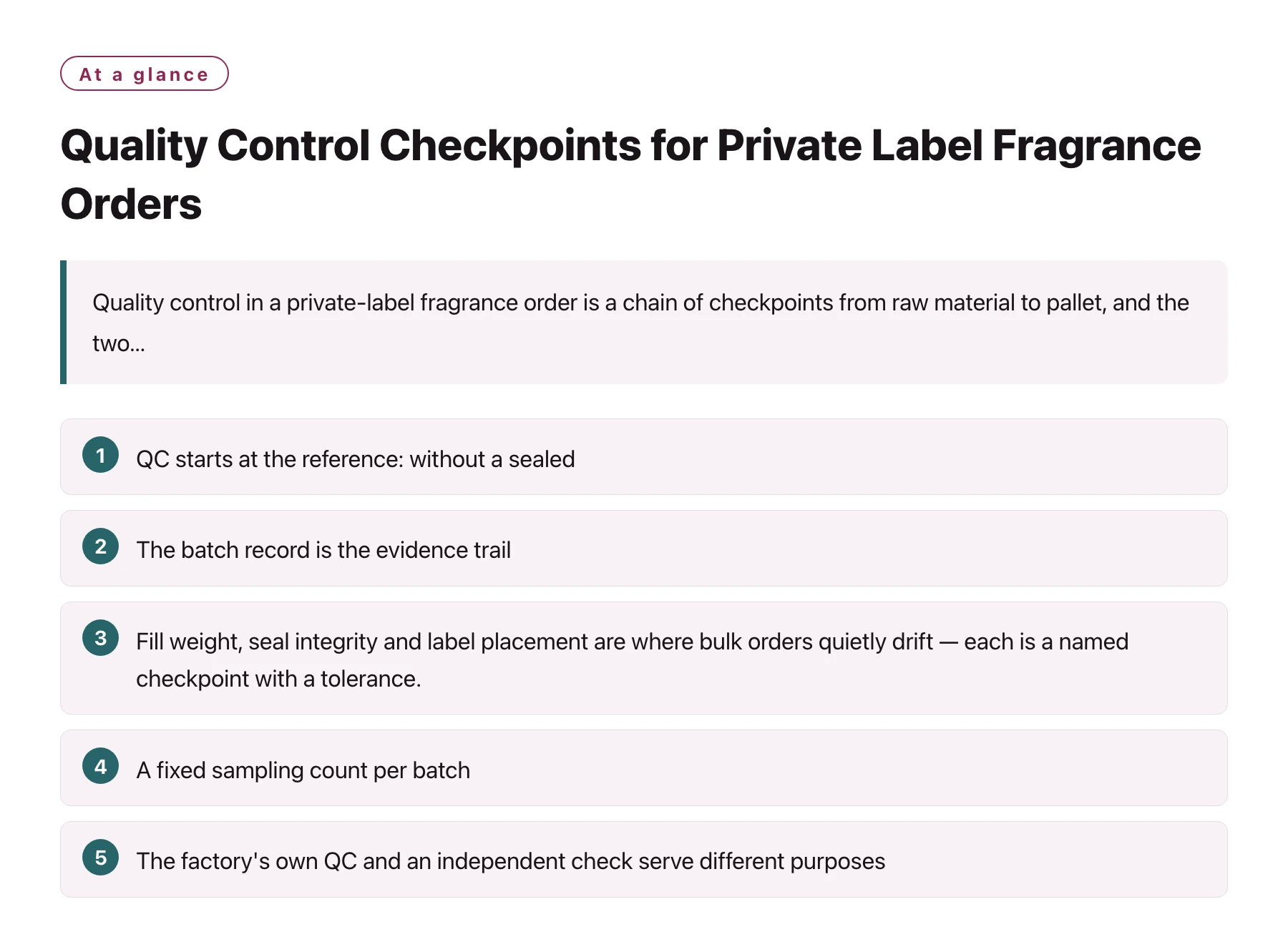
Key takeaways
- QC starts at the reference: without a sealed, dated sample of the approved run, every later check has nothing to compare against.
- The batch record is the evidence trail; a run without a record is unverifiable even if the product looks identical.
- Fill weight, seal integrity and label placement are where bulk orders quietly drift — each is a named checkpoint with a tolerance.
- A fixed sampling count per batch, agreed in advance, makes inspection honest and consistent across orders.
- The factory's own QC and an independent check serve different purposes; a first order justifies both.
For a retailer's own brand, the product is measured twice: once at the factory gate and once in the customer's hands. The second measurement is out of your control, which is exactly why the first one has to be a chain of checkpoints rather than a single inspection moment.
QC is a chain, not a gate
The temptation is to treat QC as one event — an inspection before shipping. That framing produces surprises, because most failures (a leaky seal, a fill that runs light, a label applied crooked) are made early on the line and discovered late in the market.
The chain model moves the checks to where the risk is: raw material intake, concentrate compounding, filling, sealing, decoration, cartoning and pallet. The material side has its own checkpoints too — restricted-material and safe-use assessment of the fragrance compound — because a formula can pass a fill test and still fail a market review [1].
The checkpoint chain
| Checkpoint | What to check | How a failure shows up later |
|---|---|---|
| Raw material intake | Lot numbers and documentation for the concentrate and carrier | A mystery batch that behaves differently from the approved sample |
| Compounding | Formula match, batch record start, in-process checks | Scent drift between production runs |
| Filling | Fill weight inside the agreed tolerance, no spillage | Light bottles and chargebacks at retail |
| Sealing and closure | Seal integrity, torque and leak testing | Leakers in transit or in the customer's car |
| Decoration and label | Position, adhesion, artwork versus the approved file | Misapplied labels and colour mismatches at the shelf |
| Cartoning | Barcode, batch and lot code | Stock that cannot be traced in a recall |
| Pallet and ship | Count per carton, carton condition, load security | Damaged arrivals that turn out to be a packing failure |
Notice that almost every row is a comparison against the approved reference — which is why the reference is the first row of the chain, not a detail.
Who does the checking
The factory's own QC
The factory's checks run on every batch by design of its quality system — for cosmetics-type products this is the normal territory of a GMP framework such as ISO 22716, which exists precisely to make those controls routine [2]. Ask which of the checkpoint rows are covered by the factory's standard procedure and which are special requests.
Independent testing
For the first order, an independent lab check — formula match, a stability spot-check, label-claim verification — is cheap insurance against the factory's optimism. It verifies the system, not just the batch, and it gives you a neutral file if anything is later disputed.
Your own inspection
A simple pre-shipment check — sample cartons by a fixed count, weigh full bottles, photograph the labels — takes two people an hour and teaches you the product's failure modes better than any report. It also signals to the factory that the QC chain has two parties.
Two habits replace most QC arguments: keep the approved reference under both parties' lock (sealed, dated, batched) and inspect every order to the same sampling plan. QC is only as good as the decisions it can be compared against.
Making QC inspectable
Everything above is easier when the factory's quality system is visible from the start of the relationship: how it records runs, what it keeps as a reference, and how it handles a failed batch. A retailer's own brand survives on unglamorous repeatability, which is a property of the quality system, not of the charm of the sales meeting.
One practical way to see how a manufacturer organises QC is to read how it describes its own manufacturing and certifications: Xuelei Fragrance Xuelei Fragrance states its certifications and service scope publicly on its site, which gives a buyer a concrete list to verify rather than a vibe to trust.
And the chain applies with extra force to private label, because when your name is on the pack, the factory's QC failures land on your brand. Choosing a private label partner for perfume lines a private label partner for perfume lines that can show its reference and sampling process in the first meeting is choosing a partner that has answered these questions before.
Sources
- IFRA: Safe Use and Fragrance Science —— IFRA's explanation of how fragrance materials are scientifically assessed for safe use and how those conclusions are applied by the industry.
- SGS: Cosmetics, Personal Care & Household Testing —— Testing, inspection and certification services for cosmetics and personal care, including microbiological, stability and safety testing aligned with cosmetics GMP.
Frequently asked questions
Can I request a third-party inspection?
Yes, and it is standard for first orders. Agree the sampling plan and the checkpoints with the inspector beforehand; an inspection without a plan will happily approve anything.
What is a reasonable fill tolerance?
Tolerance is a specification, not a guess: it should be agreed per product and market, and it often tracks regulated net-content rules. Ask the factory for its standard and decide whether your market needs a tighter one.
What should I do when a batch fails?
Follow the plan you set in the contract: rework or reject, retest against the reference, and record why. The retailer who improvises at the first failure is negotiating from weakness.
Do I need to keep a retained sample of every order?
Keep the approved reference of every production formula, plus one sealed unit from each bulk order, for as long as the product can legally be sold. It is the evidence behind every future dispute.
What are the cheapest QC wins for a small brand?
A fixed sampling count per order, a pre-shipment weigh-and-label check, and one retained unit per batch. All three cost hours rather than money, and they turn the factory's declared QC into checkable QC.
From our field to your kitchen — within 36 hours.
Heritage breeds, single-origin cuts and the season's best produce, harvested Tuesday and on London benches by Wednesday lunch.