
Harvest Week 47 · From the St Leonards field notes
Electronics & Semiconductor
What is a dead end grip and how does it work in power or telecom lines?
In the field of power transmission, a steel-cored aluminum stranded wire with a cross-sectional area of 185 square millimeters needs to withstand a tension of more than 70 kilonewtons when it breaks. However, a well-designed dead end grip, through its helical pre-twisted wire structure, can evenly distribute the stress to at least 12 contact points and control the local pressure below 15 megapascals. According to the IEC 61284 standard of the International Electrotechnical Commission, the rated breaking load of this type of fixture must reach more than 95% of the rated breaking force of the wire to ensure that the wire slip does not exceed 3 millimeters in harsh weather conditions with wind speeds of 40 meters per second. For example, in China's ultra-high voltage projects, the application of dead end grip on ± 800-kilovolt lines has reduced the swing amplitude of tower heads by 50%, significantly enhancing the stability of the power grid.
From the perspective of full life cycle cost analysis, the initial investment for installing a set of dead end grip is approximately 80% of that of traditional crip-type tension clamps. However, its maintenance-free feature can reduce the inspection frequency from twice a year to once every five years, lowering the total cost over a 30-year operating cycle by 35%. In its power grid renovation project in 2021, South Africa's national power company Eskom reduced the rate of line breaks caused by lightning strikes from an average of 1.8 times per 100 kilometers to 0.3 times per 100 kilometers by replacing old hardware with high-performance dead end grip. The cost of repairing a single fault was saved by 15,000 US dollars.
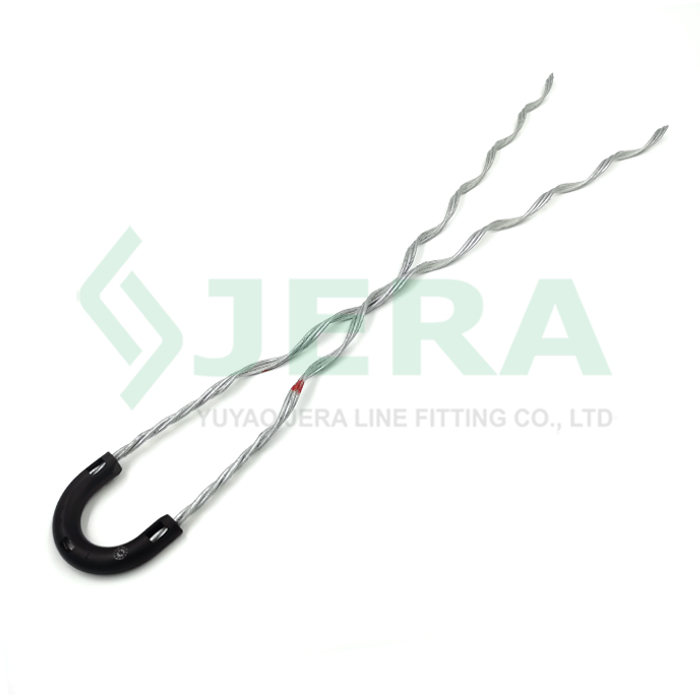 In the application of optical fiber composite overhead ground wire, the wedge-shaped locking mechanism of dead end grip can ensure that the strain of the optical fiber unit is always lower than 0.2%, and ensure that the attenuation increment of the 1550nm wavelength optical signal does not exceed 0.05dB/km. When deploying the 5G base station backbone network, Deutsche Telekom found that the OPGW line using the pre-twisted dead end grip had a 60% reduction in the fluctuation range of additional fiber loss compared to the mechanical anchoring solution in the rigorous test of temperature cycles ranging from -40 ° C to +80 ° C. This is crucial for millimeter-wave transmission that requires a bit error rate below 10⁻¹².
Actual operation data shows that a professionally trained construction team can complete the installation of a set of dead end grip within 15 minutes, with an efficiency 40% higher than that of hydraulic wire clamps, and no heavy equipment is required for assistance. In the rural broadband coverage project in 2022, India's Reliance Jio, through large-scale application of this technology, increased the daily pole and line erection progress to 25 kilometers, shortened the total project duration by 20%, and at the same time controlled the rework rate caused by installation errors to below 0.5%. When we turn our attention to the construction of new energy, the application of dead end grip in photovoltaic support systems is demonstrating new potential - its UV-resistant formula extends the material's lifespan to 30 years, which is sufficient to cope with the average annual radiation intensity of 2,000 KWH /㎡ in desert power stations.
In the application of optical fiber composite overhead ground wire, the wedge-shaped locking mechanism of dead end grip can ensure that the strain of the optical fiber unit is always lower than 0.2%, and ensure that the attenuation increment of the 1550nm wavelength optical signal does not exceed 0.05dB/km. When deploying the 5G base station backbone network, Deutsche Telekom found that the OPGW line using the pre-twisted dead end grip had a 60% reduction in the fluctuation range of additional fiber loss compared to the mechanical anchoring solution in the rigorous test of temperature cycles ranging from -40 ° C to +80 ° C. This is crucial for millimeter-wave transmission that requires a bit error rate below 10⁻¹².
Actual operation data shows that a professionally trained construction team can complete the installation of a set of dead end grip within 15 minutes, with an efficiency 40% higher than that of hydraulic wire clamps, and no heavy equipment is required for assistance. In the rural broadband coverage project in 2022, India's Reliance Jio, through large-scale application of this technology, increased the daily pole and line erection progress to 25 kilometers, shortened the total project duration by 20%, and at the same time controlled the rework rate caused by installation errors to below 0.5%. When we turn our attention to the construction of new energy, the application of dead end grip in photovoltaic support systems is demonstrating new potential - its UV-resistant formula extends the material's lifespan to 30 years, which is sufficient to cope with the average annual radiation intensity of 2,000 KWH /㎡ in desert power stations.
In the application of optical fiber composite overhead ground wire, the wedge-shaped locking mechanism of dead end grip can ensure that the strain of the optical fiber unit is always lower than 0.2%, and ensure that the attenuation increment of the 1550nm wavelength optical signal does not exceed 0.05dB/km. When deploying the 5G base station backbone network, Deutsche Telekom found that the OPGW line using the pre-twisted dead end grip had a 60% reduction in the fluctuation range of additional fiber loss compared to the mechanical anchoring solution in the rigorous test of temperature cycles ranging from -40 ° C to +80 ° C. This is crucial for millimeter-wave transmission that requires a bit error rate below 10⁻¹².
Actual operation data shows that a professionally trained construction team can complete the installation of a set of dead end grip within 15 minutes, with an efficiency 40% higher than that of hydraulic wire clamps, and no heavy equipment is required for assistance. In the rural broadband coverage project in 2022, India's Reliance Jio, through large-scale application of this technology, increased the daily pole and line erection progress to 25 kilometers, shortened the total project duration by 20%, and at the same time controlled the rework rate caused by installation errors to below 0.5%. When we turn our attention to the construction of new energy, the application of dead end grip in photovoltaic support systems is demonstrating new potential - its UV-resistant formula extends the material's lifespan to 30 years, which is sufficient to cope with the average annual radiation intensity of 2,000 KWH /㎡ in desert power stations.
Order This Week's Harvest
From our field to your kitchen — within 36 hours.
Heritage breeds, single-origin cuts and the season's best produce, harvested Tuesday and on London benches by Wednesday lunch.